Culture(16 OCTOBER)
Can a Coat Change Your Mind?
A famous 2012 experiment said a white lab coat makes you more attentive. The real story is messier, and much more interesting.
- Published
- Read
- 8 min
- Nº
- 09
- Format
- The Fold's Read
You’ve felt it. Some days a jacket makes you stand straighter. Some days the wrong shoes make you quieter in a meeting. A friend puts on her “interview blazer” and her voice changes. A footballer pulls on the shirt and becomes someone else for ninety minutes.
For more than a decade, psychologists have tried to measure that feeling. The results are fascinating, sometimes overhyped, and much more useful than the slogans you see online (“dress for the job you want!”). This is a long look at what the research actually says, what history already knew, and why it’s one of the best arguments we have that fashion is not just vanity.
The detail: a white coat
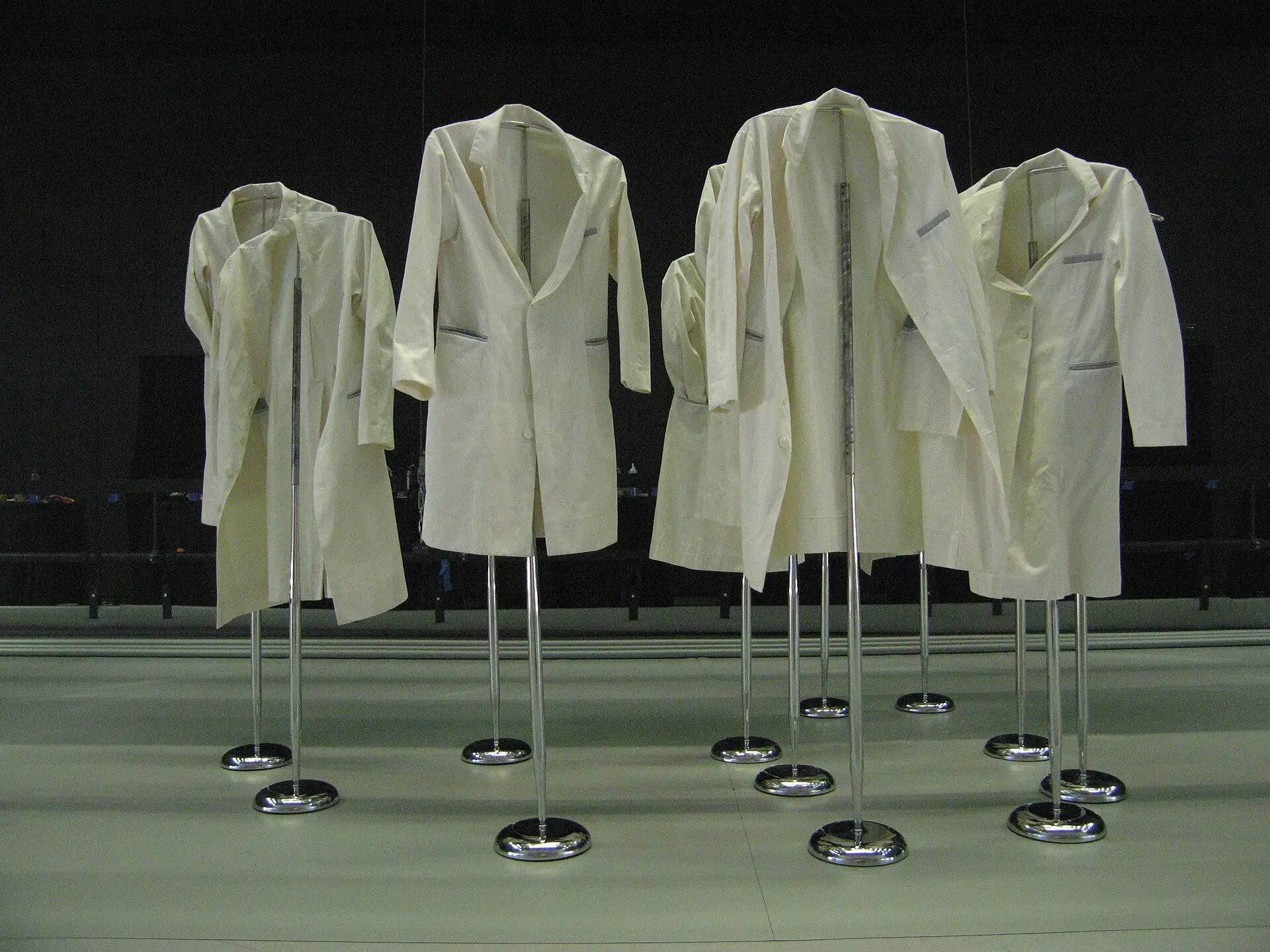
Look at the cover photo: white lab coats on stands, without anyone in them. Even empty, they say something. Careful. Precise. Scientific. Almost everyone reads them the same way. That shared meaning is exactly why researchers chose the lab coat for the most famous experiment in this field.
Case study one: the lab-coat experiment
In 2012, two researchers at Northwestern University, Hajo Adam and Adam Galinsky, published a paper with a memorable title: “Enclothed cognition.”
First they checked what people associate with a lab coat. In a small online survey, people linked it with attentiveness and carefulness. Then they ran three experiments.
In the first, people did a classic attention test called the Stroop task. You see colour words printed in the wrong colour ink, the word “red” in blue, say, and you have to name the ink colour, not read the word. It’s harder than it sounds. People wearing a lab coat made fewer errors than people in their own clothes.
The second and third experiments were the clever part. Everyone got the same white coat, but it was described differently. When it was called a doctor’s coat, wearers paid closer attention on a task spotting differences between pictures than when it was called a painter’s coat. And simply seeing a doctor’s coat on the desk, or writing about what it meant to them, didn’t produce the same effect. You had to wear it.
From this, Adam and Galinsky proposed their big idea. Clothes affect the wearer’s mind through two things at once: the symbolic meaning of the garment, and the physical experience of wearing it. Meaning without wearing didn’t work. Wearing without meaning (the painter’s coat) didn’t work as well. You needed both.
It was a beautiful, simple story, and it spread everywhere: talks, business books, endless “power dressing” articles.
The catch: science checks itself
Here’s the part that usually gets left out.
In 2019, a team led by Daniel Burns ran the first experiment again, the Stroop test with and without the lab coat. They registered their plan in advance, so they couldn’t change the analysis after seeing the data, and they used more than three times as many participants and three times as many trials. Wearing the lab coat made no meaningful difference to speed or accuracy.
That doesn’t mean the original researchers did anything wrong. Small studies often find effects that look bigger than they really are, and science moves forward by repeating them. But it does mean the most quoted claim, a lab coat makes you more attentive, isn’t proven. If there’s an effect on that task, it’s too small to rely on.
We think that’s worth saying clearly, because a lot of fashion writing quotes the 2012 study as fact. It’s also why we didn’t use the statistic in the post that inspired this story. It said 35% of people felt a day had gone better than expected because of their clothes, crediting a 2023 thesis. We read the thesis and couldn’t find that figure in it.
So is the whole idea dead? No. It’s just that the evidence is more interesting than the slogan.
Case study two: the suit and the sweatpants
In 2014, Michael Kraus and Wendy Berry Mendes ran a study that tested clothes in a real social situation. Men were dressed in one of three outfits: a black suit with a white shirt and leather shoes; a white T-shirt, blue sweatpants and plastic sandals; or their own everyday clothes. Then they negotiated a mock business deal with another man who didn’t know that clothing was part of the experiment.
The men in suits made fewer concessions and earned more profit than the men in sweatpants. The researchers also measured hormones from saliva. After the negotiation, the men in sweatpants showed a drop in testosterone, a hormone linked to dominance, compared with both other groups. The suit didn’t boost anyone. The cheap outfit seemed to pull people down.
The partners reacted too. Facing someone in a suit, they showed physical signs of being more on guard, and rated themselves as less powerful.
That’s the important bit. Clothes don’t just work inside your head. They work in the space between people. Your outfit changes how others treat you, which changes how you behave, which changes how they treat you. It’s a loop.
Case study three: dressing up, thinking big
A year later, in 2015, a team led by Michael Slepian looked at formal clothes and the way people think. Across five studies, people who were wearing, or had just been wearing, more formal clothes tended to think more abstractly, seeing the bigger picture rather than the details. The researchers linked this to a feeling of power and distance: dressing up seems to make people feel a little more in charge and a little more removed from small concerns.
None of these studies is perfect, and the effects are modest. But together they point the same way: clothing works through meaning, through the body, and through other people.
What history already knew
Researchers gave it a name in 2012. People have used it for thousands of years.
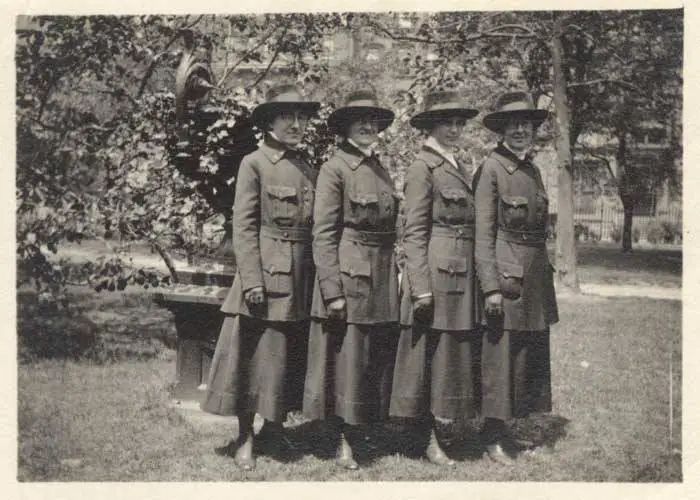
Uniforms are the clearest example. Soldiers, nurses, judges, police, chefs, school pupils: the uniform tells everyone what role you’re playing, and it tells you too. Putting on a uniform is a ritual of becoming. The four nurses above were about to leave for a war hospital. Matching coats and hats turned four individuals into a unit, to themselves and to everyone who saw them. One of them, Abbie Ewart, wrote in her diary as their ship passed the Statue of Liberty: “we seemed to leave a little of us behind.”
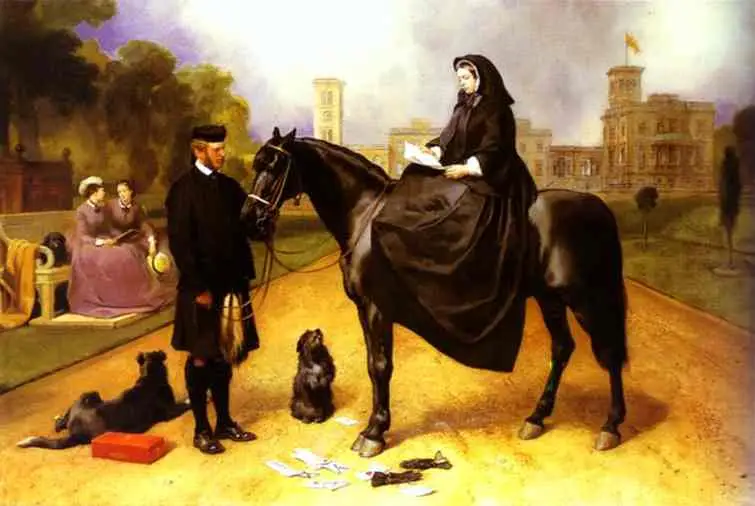
Mourning dress did something similar for grief. In 19th century Britain, the clothes of mourning followed strict stages, deep black first, then softer greys and purples over months or years. They told the street that someone was grieving and should be treated gently. They also gave the grieving person a structure: you knew what to wear today, even when nothing else made sense. After Prince Albert died in 1861, Queen Victoria wore black for the rest of her life, forty years. Her clothes became her public statement of loss.

Work clothes carry identity too. The photo above is Barbara McClintock in her lab in 1947, in a plain light work coat, decades before her Nobel Prize. For a woman in science at that time, looking the part wasn’t vanity. It was part of being taken seriously in a room that often didn’t want her there.
Case study four: a skirt that ended a war
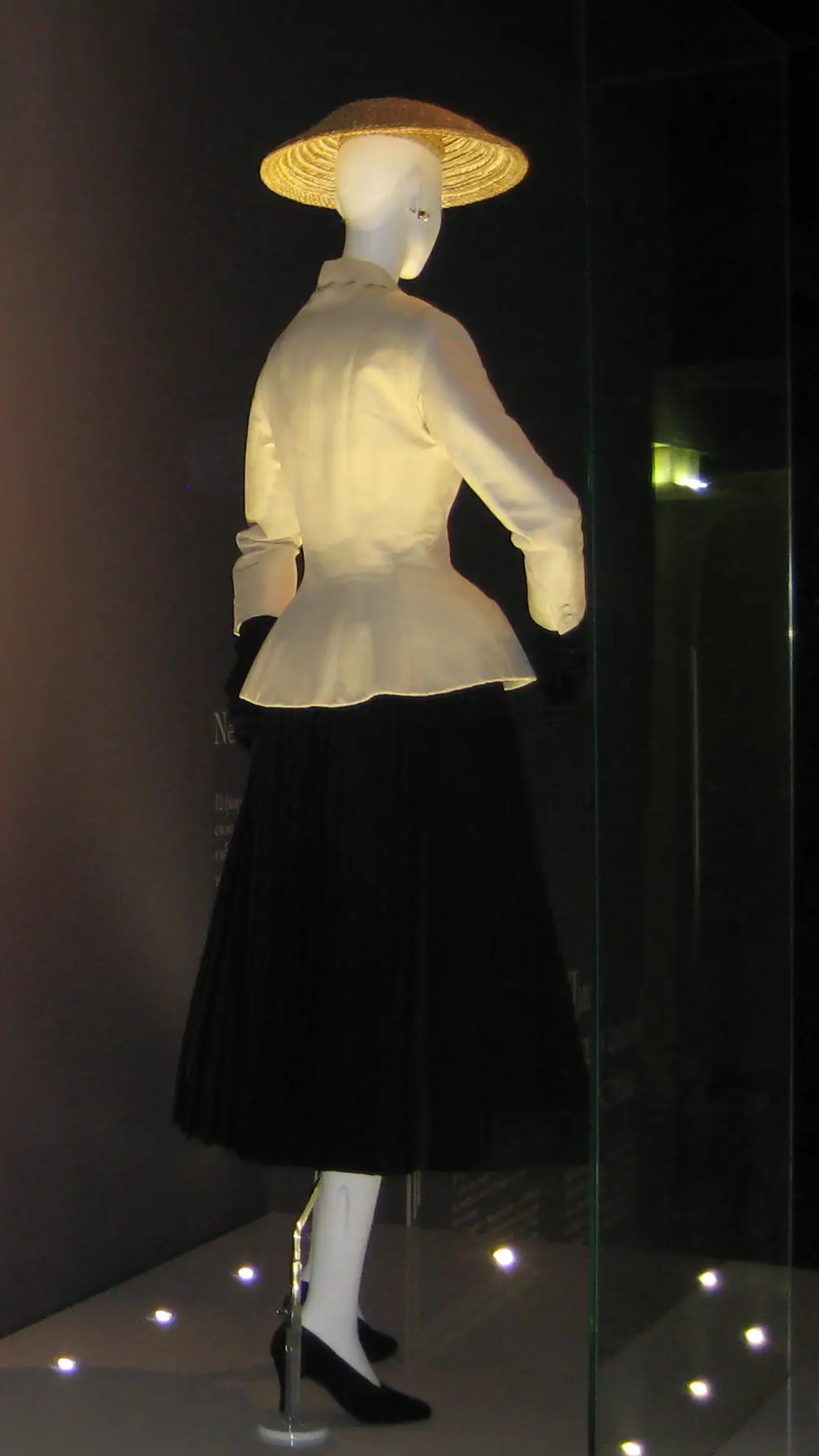
The same year as that lab photo, on 12 February 1947, Christian Dior showed his first collection in Paris. Its star was the Bar suit: a fitted cream jacket padded at the hips, a cinched waist, and a pleated black skirt that used a huge amount of fabric. The American editor Carmel Snow told him his dresses had “such a new look,” and the name stuck.
To understand why it caused such a storm, remember the context. For years, war rationing had limited how much cloth anyone could use. Skirts were short and narrow by law in some countries. The New Look spent fabric like the war was over. Some people were furious, calling it wasteful and backward, and in Britain politicians criticised it while rationing was still in force. Many women loved it anyway, and the silhouette spread around the world within a few years.
The New Look didn’t change anyone’s body. It changed what clothes meant. After years of making do, a full skirt meant hope, abundance and a future. That’s enclothed cognition at the scale of a whole society, two things at once again: a meaning, and a physical feeling of fabric moving around your legs.
The newest research: dressing to cope
The most recent work looks less at test scores and more at feelings. In 2023, Malgosia Wenderski at the University of Lethbridge in Canada surveyed 574 young adults aged 18 to 29 about their clothes during the pandemic, when many people barely left home.
The findings are human and a little surprising. People who were more afraid of Covid tended to be more involved with fashion, not less, and more likely to use clothes to change their mood. Participants described dressing to protect their self-esteem, to feel like themselves, to feel comfortable or to feel capable, even when nobody would see them. Those who stopped caring about what they wore often said they felt less connected to themselves.
The study found no direct statistical link between dressing for mood and overall mental health scores. But in their own words, people described clothes as a way of coping. That honesty matters. Clothes aren’t therapy. They can be a daily tool that helps.
Our read, developed
Why it matters
People sometimes say fashion is vain. This research, and all that history, says the opposite. Choosing what to wear is a small, daily decision about who you are going to be today, and how you want the world to meet you. Uniforms, mourning clothes, a wedding dress, a first suit, a skirt that used too much fabric in 1947: humans have always used clothes to mark who they are and what they’re going through.
Fashion is the craft that gives that habit a vocabulary. The better you can read it, the better you can use it.
Even our name gets in on it. A good pair of trousers can change how you feel about your own fold. Ask anyone who has finally found the right jeans.
Your turn: what’s the one piece you put on when you need to feel like yourself, and what does it mean to you?
Free with The Letter · PDF
The Detail Glossary.
50 terms to read clothes by, from bias cut to bartack. One plain line on what each one is, one line on where to spot it. Join The Letter and the download is yours straight away. Then one email every other Sunday: three details, five minutes.
Your address is used only to send The Letter. It is stored by our host, Netlify, and never sold or shared. Reply "stop" to any edition and you are off the list. What an edition looks like.